

MD&A · 2025
In this section4 topics
Overview of Operations
Overview of Operations
Executive Summary
In 2025, against the backdrop of multi-facet challenges, largely attributable to both cyclical and structural impediments stemming from direct and indirect repercussions of Trump tariffs, a slower-than-anticipated recovery in the tourism sector, and persistently weak domestic demand underscoring high household indebtedness, credit appetite was collectively muted across commercial and retail customer segments.
Amid this operating landscape, Krungsri remained steadfast in executing our strategic priorities for the year, with a continued emphasis on asset-liability management efficacy, enhancing operational efficiency, and maintaining a prudent approach to risk management, while pro-actively assisting vulnerable groups of customers impacted by the subpar growth environment.
In this light, in support of sustaining our customer business momentum and assisting vulnerable customer groups as well as corresponding to multiple rounds of policy rate reduction in 2025, Krungsri lowered key lending rates in the range of 0.505% to 0.85%, while maintaining the savings deposit rate. Furthermore, we have actively partaken in the “You Fight, We Help” program, encompassing both debt restructuring and lowering debt servicing burdens in assistance of vulnerable customers resulting in 85,012 accounts being enrolled with Baht 29,335 million in debt amount.*
(*Excluding TIDLOR data).
In parallel, the Bank reinforced our medium- and long-term strategic focus on financial inclusion, while capitalizing on growth opportunities within underserved retail and SME segments. A key milestone in this regard was the increase of Krungsri’s equity stake in Tidlor Holdings Public Company Limited (TIDLOR), which rose from 30.18% to 46.51% in the second half of 2025, further solidifying our position as a major shareholder.
Consequently, Krungsri Group (the Bank and its business units) reported a net profit of Baht 31,739 million for the year, marking an increase of Baht 2,039 million, or 6.9% compared with the prior year.
This improvement was driven by a one-time gain associated with TIDLOR investment remeasurement, non-interest income growth, and an increase in net interest income, supported by effective liquidity and funding cost management and from consolidation of TIDLOR’s portfolio during the period.
However, the aforementioned gains were partially offset by an increase in operating expenses pertaining to higher employee expenses, mainly attributed to TIDLOR’s consolidation and one-time voluntary early retirement program and other expenses, which mainly resulted from expenses pertaining to overseas subsidiary goodwill impairment recorded in 2H/25.
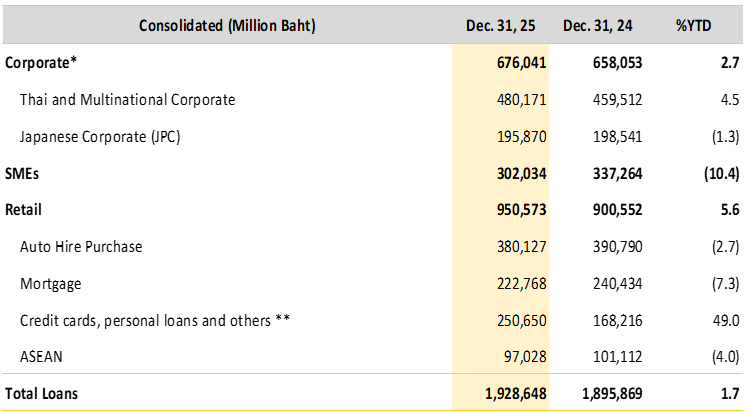
With a consolidation of TIDLOR’s loans, as of December 31, 2025, total loans outstanding was Baht 1,928,648 million, representing an increase of Baht 32,779 million, or 1.7%, from the end of December 2024, mainly driven by retail loans from the consolidation together with an expansion in corporate loans, while being partially offset by a contraction in SME loans.
Underlining our proactive effort to manage liquidity and funding cost amid tepid credit conditions, total deposits stood at Baht 1,735,328 million, decreasing by Baht 86,901 million, or 4.8%, from the end of December 2024, largely from a reduction in time deposits.
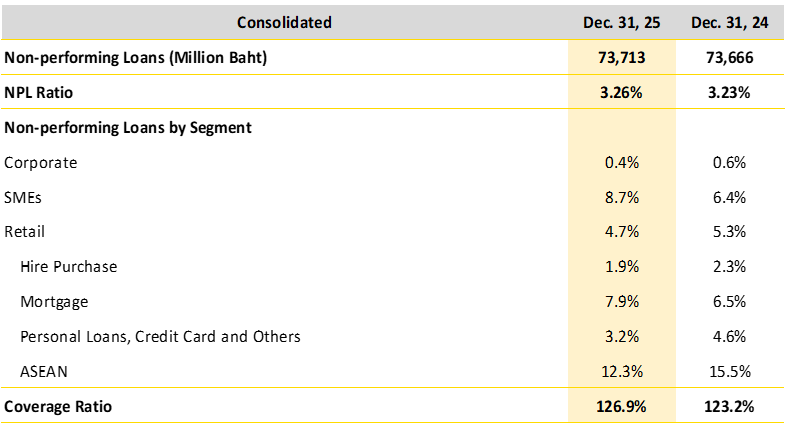
The non-performing loan (NPL) ratio was at 3.26%, compared with 3.23% at the end of December 2024. Adhering to our continued prudential management, the credit cost was recorded at 227 basis points (bps), maintaining an adequate and appropriate level of expected credit loss (ECL), while taking into account future economic risks and uncertainty. The loan loss coverage ratio was at 126.9%, improving from 123.2% at the end of December 2024.
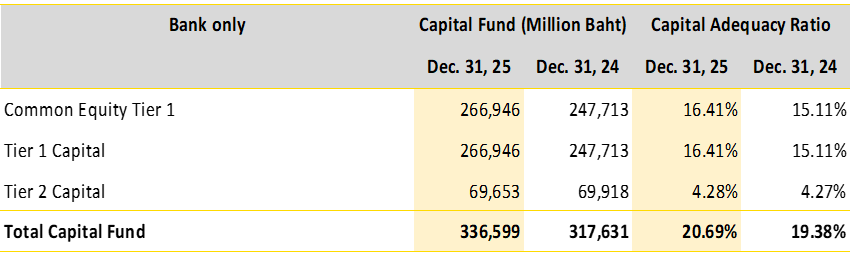
The capital adequacy ratio (Bank only) improved to 20.69%, up from 19.38% at the end of December 2024.
Operating Results & Financial Condition
Operating Results & Profitability
Key Items of Operating Performance
Net Interest Income
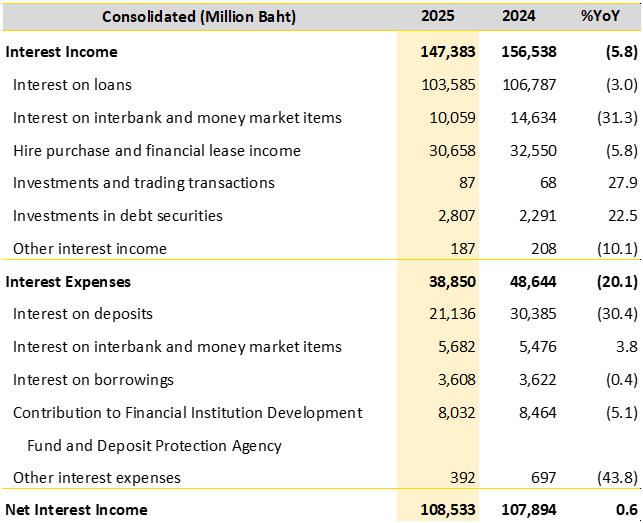
Notwithstanding the significant impact of multiple interest rate reductions corresponding to the policy rate reductions and contraction in loan growth across customer segments in 2025, net interest income increased by Baht 639 million, or 0.6%, primarily resulting from well-managed funding costs together with the interest income contribution from TIDLOR.
The interest income for 2025 amounted to Baht 147,383 million, a decrease of Baht 9,155 million or 5.85% from 2024, mainly due to lower interest income from loans, interbank and money market, and hire purchase and financial lease income attributed to loan contraction stemming from the tepid credit demand and the impact of policy rate cuts. The aforementioned impacts were partly ameliorated by the contribution from TIDLOR in 2H/25.
Meanwhile, interest expenses decreased by Baht 9,794 million, or 20.1% from 2024, mainly due to notable reduction of interest on deposits, corresponding to Krungsri’s proactive funding cost management resulting in deposit composition and tenor adjustments, together with a lower deposit balance.
Net Interest Margin
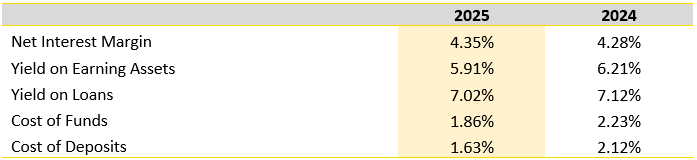
Notwithstanding multiple interest rate cuts and lowered average earning in 1H/25 prior to the TIDLOR consolidation, our proactive funding cost management together with higher yield contribution from TIDLOR in 2H/25, net interest margin (NIM) expanded to 4.35%, an increase by 7 basis points (bps) from 2024.
Non-Interest Income
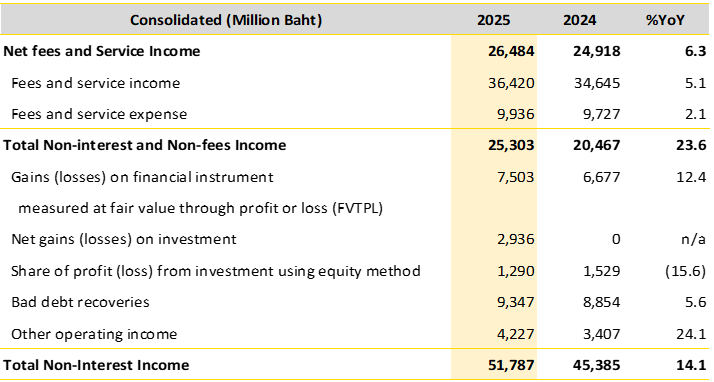
In 2025, non-interest income totaled Baht 51,787 million, increasing by 14.1% or Baht 6,402 million, from 2024. The increase was mainly due to higher net fees and service income of Baht 1,566 million, one-time gain associated with TIDLOR investment remeasurement of Baht 2,801 million which was booked in 2H/25, gains on financial instruments measured at fair value through profit or loss (FVTPL) of Baht 826 million and bad debt recovery of Baht 493 million, while being partly offset by a decrease in share of profit from investment using equity method of Baht 239 million.
Fees and Service Income Breakdown1)
Remark:
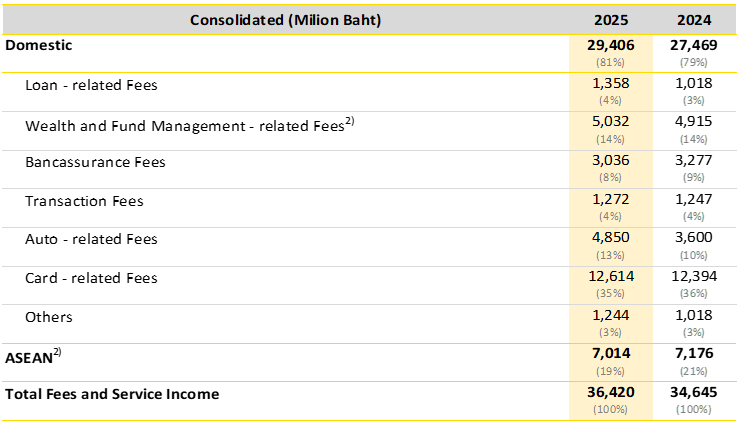
1) Figure % in ( ) represents percentage of total fees and service income.
2) Fees and Service Income Breakdown was regrouped in 2025, through 1) an introduction of ‘ASEAN’ fees
and service income category and 2) an introduction of ‘Wealth and Fund Management-related Fees’, of
which were grouped under ‘Others’ previously. (Note: 2024 figures were then regrouped
accordingly).
In 2025, fees and service income amounted to Baht 36,420 million, increasing by 5.1% from 2024 mainly due to an increase in domestic fees and service income of Baht 1,937 million, partly offset by a lowered ASEAN fees and service income of Baht 162 million. The growth in domestic fees and service income was largely attributed to an increase in auto-related fees (Baht 1,250 million), loan related fees (Baht 340 million), card related fee (Baht 220 million) and wealth and fund management-related fees (Baht 117 million) while being partly offset by a lowered bancassurance fees (Baht 241 million).
Operating Expenses
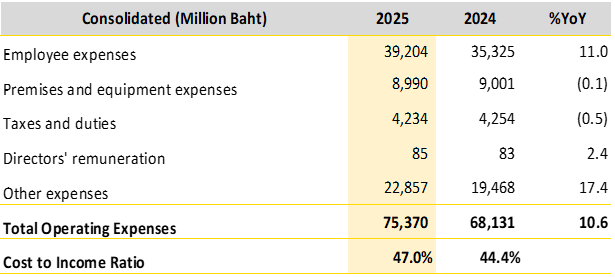
In 2025, total operating expenses amounted to Baht 75,370 million, increasing by 10.6%, or Baht 7,239 million from 2024. This was largely driven by higher employee expenses (Baht 3,879 million) mostly resulting from TIDLOR’s consolidation and expense pertaining to a one-time voluntary retirement program in 4Q/25 and other expenses, which mainly attributed to expenses pertaining to an overseas subsidiary goodwill impairment (Baht 2,580 million) which recorded in 3Q/25, IT service expenses (Baht 217 million) and promotion expenses (Baht 214 million).
With TIDLOR consolidation, for 2025, the cost-to-income ratio was 47.0% increasing from 44.4% in 2024.
Expected credit loss (ECL)

Adhering to our continued prudential management, the expected credit loss in 2025 was recorded at Baht 43,790 million, equivalent to a credit cost of 227 bps, compared with the 245-bps level for 2024. The aforesaid safeguard was to ensure an adequate and appropriate level of expected credit loss, while taking into account heightened economic risks and uncertainty. As a result, the coverage ratio improved to 126.9% at the end of December 2025.
Liquidity & Capital Adequacy
Liquidity

The loan-to-deposit ratio was 111% as of the end of December 2025, compared with 104% at the end of December 2024.
Meanwhile, the loan-to-deposit plus debentures ratio stood at 107% as of the end of December 2025, compared with 101% at the end of December 2024.
Statutory Capital
As of December 31, 2025, Krungsri’s capital (Bank only) stood at Baht 336,599 million, equivalent to 20.69% of risk-weighted assets, comprising Common Equity Tier 1 (CET1) and Tier 1 Capital of 16.41% and Tier 2 capital of 4.28%.
The current level of capital is well above the minimum regulatory capital requirements which include the capital conservation buffer and higher loss absorbency (the additional CET1) requirement for Domestic Systemically Important Banks (D-SIBs).
Asset Management Capability
Key Items of Financial Position
Assets
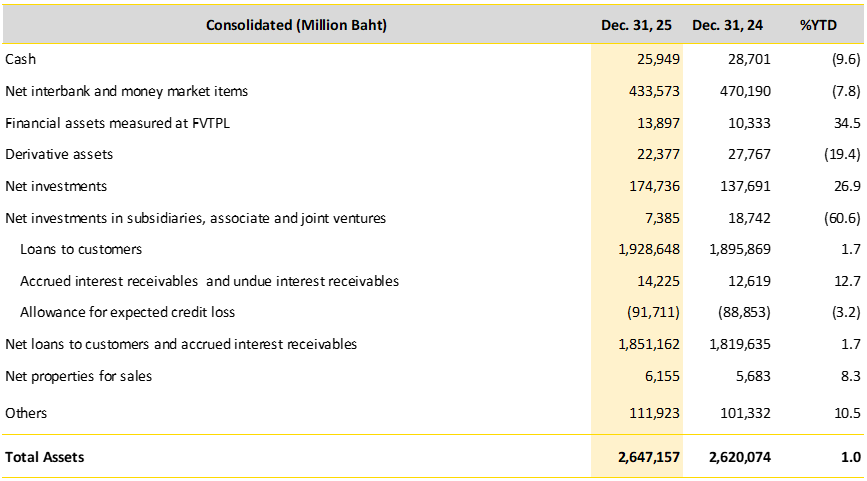
Compared with the end of December 2024, total assets increased by Baht 27,083 million, or 1.0%.
Key drivers are as follows:
o Net investments increased by 26.9%, or Baht 37,045 million, mainly from an increase in the Bank’s
investment in debt securities measured at amortised cost and measured at fair value through other
comprehensive income (FVOCI).
o Loans to customers increased by Baht 32,779 million, or 1.7%, driven by corporate and retail loans
expansion underscoring our selective quality growth strategy and TIDLOR’s consolidation, offset by
a decrease in SME loan.
o Meanwhile, net interbank and money market items decreased by Baht 36,617 million, or 7.8%,
primarily due to a decrease in repurchase agreements of Baht 56,905 million, partially offset by an
increase in deposits at financial institutions and loans to financial institutions totaling Baht 20,288
million. This movement reflects Krungsri’s close monitoring of market conditions and ongoing review
of interest rate changes to ensure timely and appropriate responses to development in the money
markets.
Investments
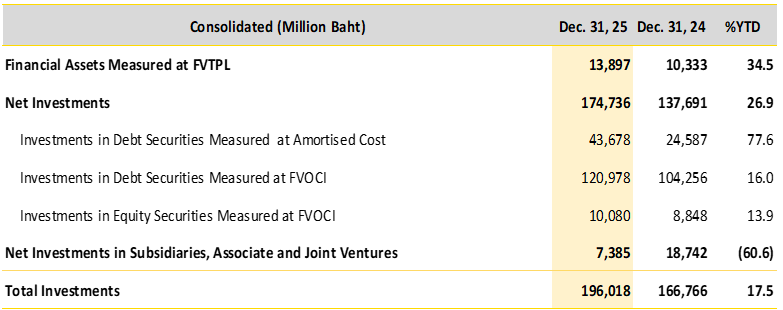
Compared with the end of December 2024, total investments increased by Baht 29,252 million, or 17.5%, mainly from investment in debt securities measured at amortised cost and investment in debt securities and equities securities measured at fair value through other comprehensive income (FVOCI), partly offset by a decrease in net investment in subsidiaries, associate and joint ventures.
Loans to Customers
Loans by Segment
Remark:
* Starting from January 1, 2025, the Multinational Corporate (MNC) loan portfolio was regrouped from the JPC &
MNC segment to the Thai and MNC segment. (Note: As of the date of regrouping, the MNC portfolio balance was
Baht 25,981 million.)
** Starting from August 13, 2025, credit cards, personal loans and others included loans from TIDLOR.
Loan Breakdown
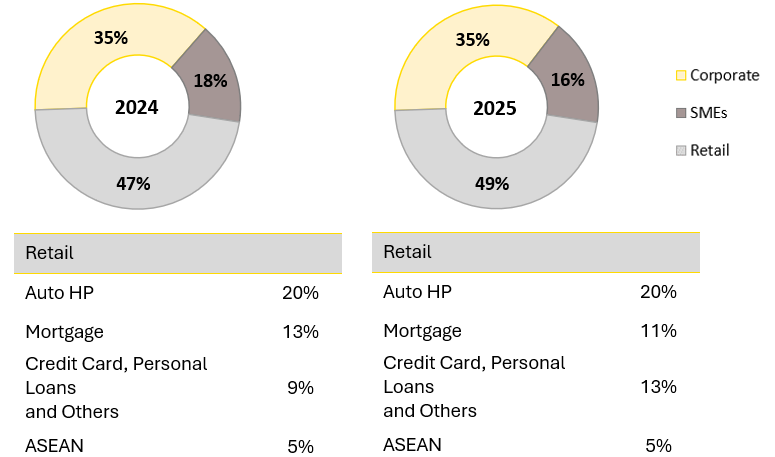
In 2025, resonating the multifaceted challenges underscoring the operating environment, combined with the Bank’s selective growth strategy to preserve credit quality, total loans increased by 1.7%, or Baht 32,779 million from the end of 2024, largely driven by Thai and multinational corporate segments. Furthermore, loan growth was also supported by the consolidation of TIDLOR portfolio in 2H/25. Meanwhile, weak domestic demand and weighted down business sentiments resulted in the loan contractions for both retail and SME segments.
Underscoring our selective quality-growth strategy, corporate loans increased by 2.7%, or Baht 17,988 million, from the end of December 2024.
o Underscoring the credit demands from both industrial and services sectors, Thai and Multinational
Corporate loans increased by 4.5%, or Baht 20,659 million, from the end of December 2024.o Japanese Corporate (JPC) loans contracted by 1.3%, or Baht 2,671 million from 2024, accentuating
loan repayments and Japanese corporates’ cautious views on Thailand’s subpar growth outlook.Underlying the Bank’s cautious credit underwriting in light of credit developments and quality, SME loans contracted by 10.4%, or Baht 35,230 million, from the end of December 2024.
Excluding the contribution from TIDLOR’s portfolio, weak domestic purchasing power and confidence amidst high household indebtedness resulted in a contraction of retail loans across segments. Incorporating TIDLOR’s portfolio consolidation in 2H/25, retail loans increased by 5.6%, or Baht 50,021 million, from the end of December 2024.
o Mirroring a lackluster domestic car sale together with the tighter credit conditions amidst
deteriorating debt-servicing capacity of customers, auto hire purchase loans decreased by 2.7%, or
Baht 10,663 million from the end of December 2024.
o Mortgage loans contracted by 7.3%, or Baht 17,666 million, from the end of December 2024 as the
Bank remained cautious in credit underwriting amid a slow demand in the housing market.
o Largely driven by the consolidation of TIDLOR’s portfolio in 2H/25, credit card, personal loans, and
others robustly grew by 49.0%, or Baht 82,434 million, from the end of December 2024.
o ASEAN loans contracted by 4.0%, or Baht 4,084 million, from the end of December 2024.
Asset Quality
Loan Classification
Non-performing Loans*
*Excluding accrued interest in accordance with the BOT’s guideline
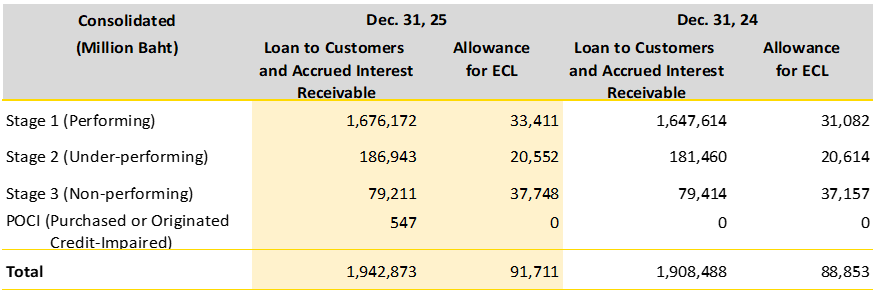
Overall asset quality in 2025 remained sound.
Compared with the end of December 2024, gross NPLs relatively stable as corporate and overall retail segment continued to illustrate an improving trend.
As a result, the NPL ratio was 3.26% as of the end of December 2025, compared with 3.23% at the end of December 2024.
With ongoing efforts to resolve NPLs, the Bank sold Baht 2,772 million of NPLs in 2025.
Consistent with our prudent risk management approach, the Bank set aside an additional expected credit loss to strengthen loss-absorbing capacity. The coverage ratio stood at 126.9% at the end of December 2025, compared with 123.2% at the end of December 2024.
Liabilities and Shareholders’ Equity
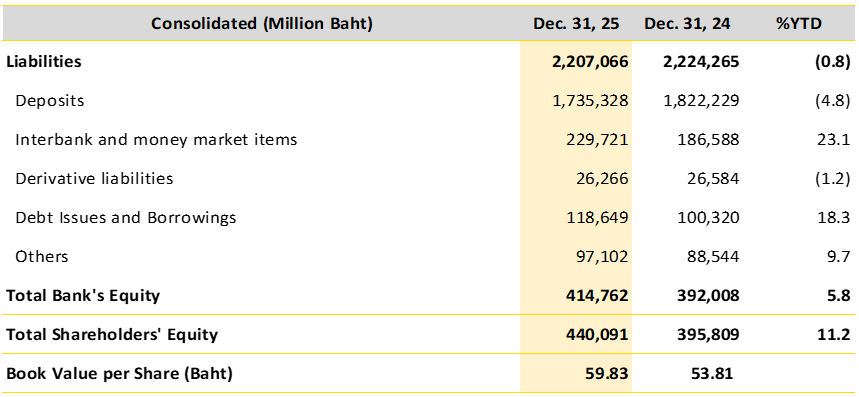
Compared with the end of December 2024, total liabilities decreased by Baht 17,199 million, or 0.8%, largely driven by deposit contraction. Key items are as follows:
o Deposits decreased by Baht 86,901 million, or 4.8%, mostly underscored by a decline in term
deposits with tenor of six months and less than one year, while being partially offset by an increase
in shorter tenor deposits with less than six months and savings deposit.
o Interbank and money market items increased by Baht 43,133 million, or 23.1%, driven by an increase
in loans from financial institutions of Baht 26,774 million, deposit from financial institution of Baht
8,271 million and repurchase agreements of Baht 8,089 million.
o Debt issues and borrowings increased by Baht 18,329 million, or 18.3%, driven by higher debentures
resulting from TIDLOR consolidation in 3Q/25, while being partially offset by the maturity of the
Bank’s and subsidiaries’ long-term debentures.
As of December 31, 2025, total Bank’s equity stood at Baht 414,762 million, representing an increase of Baht 22,754 million, or 5.8%, from the end of December 2024 due to an increase in net profit of the Bank’s equity holders by Baht 31,739 million in 2025, which was partially offset by dividends paid of Baht 6,252 million.
Book value per share as of December 31, 2025, increased to Baht 59.83 from Baht 53.81 at the end of December 2024.
Funding Structure
Deposits
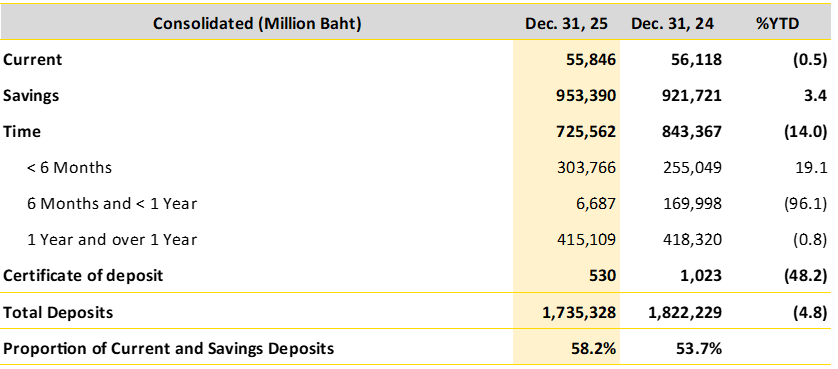
Compared with the end of December 2024, deposit decreased by Baht 86,901 million, or 4.8%. The decline was primarily driven by reductions in time deposits with tenor of six months and less than one year, in line with the Bank’s proactive liquidity and funding management amid subdued loan growth, while being partially offset by an increase in time deposits with tenor less than six months and savings deposits.
Consequently, the composition of deposits consisted of 58.2% in current and savings deposits (CASA) as a percentage of total deposits, improved from 53.7% at the end of December 2024.
Borrowing
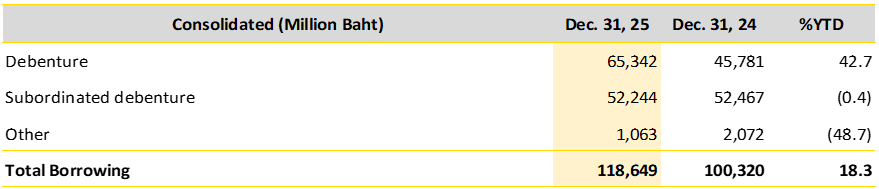
Compared with the end of December 2024, total borrowing increased by Baht 18,329 million, or 18.3%, mainly due to TIDLOR’s debentures, while being offset by the maturity of the Bank and subsidiaries’ debentures. Details are as follows:
o The maturity of the Bank’s debentures totaling Baht 7,000 million.
o The maturity of subsidiaries’ debentures totaling Baht 6,113 million.
Debt Obligations & Off-Balance-Sheet Management
Contingencies
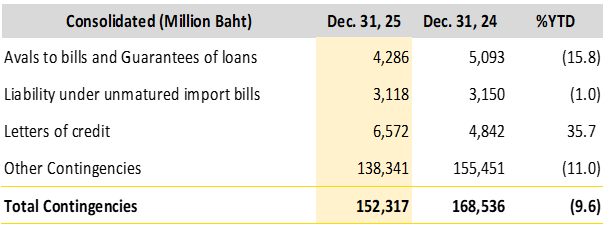
Compared with the end of December 2024, Krungsri Group’s contingencies decreased by 9.6% or Baht 16,219 million, mainly due to a decrease in Avals to bills and guarantees of loans and other contingencies, while being offset by an increase in letters of credit.
Debt Securities with Financial Ratio Requirements
Debt Securities with Financial Ratio Requirements Issued?
No
Factors That May Affect Financial Condition
Factors or Incidents That May Materially Affect Financial Condition
Key Developments in 2025
Krungsri:
Business & Financial Operations:
Key changes in deposit and lending rates are as follows:
o Deposit rates:
Decreases in a range of 0.35-0.45% in the 3-month deposit rates
Decrease in a range of 0.30-0.45% in the 6-month deposit rates
Decreases in a range of 0.50-0.60% in the 12-month deposit rates
Decreases in a range of 0.55-1.00% in the 24-month deposit rates
o Lending rates:
A decrease of 0.505% in Minimum Loan Rate (MLR) to 6.650%
A decrease of 0.850% in Minimum Overdraft Rate (MOR) to 6.475%
A decrease of 0.505% in Minimum Retail Rate (MRR) to 6.770%
Customer Assistance Measure:
In March 2025, Krungsri introduced special assistance measures for earthquake-impacted individual and SME customers, including reduction of installment amounts, grace periods on principal repayment, extension of repayment period, and reduction of minimum monthly payment rates.
In July 2025, Krungsri announced emergency relief measures for retail, SME, and auto-hire purchase customers affected by flooding from Tropical Storm Wipha and unrest along border areas. The support includes reduced installments, grace periods on principal with interest-only payments for up to 3–6 months, and tailored assistance for both small and SMEs as well as Krungsri Auto customers.
Progress of the Bank of Thailand’s “You Fight, We Help” Debt Relief Program
Krungsri provided customer assistance through the “You Fight, We Help” debt relief program for SME and retail customers who are vulnerable groups with debt servicing problems, while addressing household debt problem sustainably.
Progress Under Phase 1: As of the end of December 2025, Krungsri recorded 156,612 accounts registering for this program, of which 68,442 accounts or 43.7% were eligible, representing Baht 23,342 million in value. The aforementioned 68,442 accounts represented 33.7% of total program eligibility, while constituting 44.5% of program eligibility in terms of loan outstanding.
Progress Under Phase 2: As of the end of December 2025, Krungsri recorded 56,257 accounts registering for this program, of which 16,570 accounts or 29.5% were eligible, representing Baht 5,993 million in value. The aforementioned 16,570 accounts represented 4.3% of total program eligibility, while constituting 22.7% of program eligibility in terms of loan outstanding.
Throughout 2025, Krungsri is exercising prudence in safeguarding asset quality by closely monitoring customer conditions and market developments, while continuing to support customers through difficult periods in alignment with the responsible lending principle to ease financial pressures and promote a sustained recovery.
Acquisition of Additional Stake in Tidlor Holding:
In August 2025, Krungsri completed the acquisition of an additional 16.33% stake (472.9 million shares) in Tidlor Holdings, increasing its shareholding from 30.18% to 46.51% reinforcing its position as a major shareholder and supporting its strategy to expand financial inclusion and capture growth opportunities in underserved retail and SME segments.
Environmental, Social and Governance (ESG):
Sustainable Finance
Krungsri has declared Krungsri Net Zero Vision committing to decarbonizing our own operations by 2030 and financial services by 2050, under which the Bank commits to growing the Social and Sustainable Finance (SSF) portfolio to Baht 250,000 million by 2030. As of December 31, 2025, Krungsri’s SSF, accumulated since 2021, amounted to Baht 255,606 million.
ESG Bond
With strong commitment to advancing ESG initiatives and sustaining its leadership in ESG finance, for 2025, the Bank secured a substantial 15.9% share of ESG bond issuances across corporates, state-owned enterprises, and government entities, underscoring our strong market position and comprehensive suite of ESG financing solutions and advisory services. A significant portion of the Bank’s facilitation was in sustainability-linked bond issuances. The SSF information is available on the Bank’s website, www.krungsri.com (Investor Relations > Sustainable Finance > SSF Disclosure).
Regulatory Developments:
Monetary Policy:
In 2025, the Bank of Thailand’s Monetary Policy Committee (MPC) reduced the policy rate four times from 2.25% to 1.25% primarily to combat a slowing economy facing weak private consumption, declining export growth attributed to Trump tariffs, and high household debt, all while inflation remained subdued, providing room for easing; these cuts aimed to lower borrowing costs, support vulnerable groups, and stimulate overall economic recovery by making financial conditions more accommodative.
Financial Institution Policy:
In March 2025, the Bank of Thailand announced the temporary relaxation of the LTV ratio to 100% from an earlier cap of 70-90%, to support the real estate sector and related businesses, effective from May 1, 2025, to June 30, 2026, for mortgages, covering (1) properties valued less than Baht 10 million from the second loan onwards and (2) properties valued Baht 10 million or more from the first loan onwards.
Also, the Bank of Thailand announced the guidelines requesting financial institutions and non-banks to urgently consider providing appropriate assistance to those affected by the earthquake. During the relief period, the debt classification criteria will be relaxed by allowing the pre-disaster classification to remain unchanged.
In May 2025, the Thailand Taxonomy Board released Thailand Taxonomy Phase 2, covering the agriculture, construction and real estate, manufacturing, and waste management sectors, a continuation of Phase 1 which focuses on the energy and transportation sectors. The framework as a reference tool for sustainable economy now covers approximately 95% of Thailand’s total greenhouse gas emissions.
In June 2025, the Minister of Finance, with the advice of the Bank of Thailand, approved three virtual bank licenses for successful applicants. The decision followed a thorough review process aimed at promoting innovation, enhancing financial inclusion, particularly for the underserved segment, and fostering open competition.
In July 2025, the “You Fight, We Help” debt relief program was extended to Phase 2 which expands the eligibility and conditions of existing measures and introduces new temporary relief measures namely, Measure 1: Complete Payment, Retain Assets (“Jai Trong Kong Sap”), Measure 2: Pay-Deal-Done (“Jai-Pid-Job”), and Measure 3: Pay-Reduce-Principal (“Jai-Tud-Ton”).
In November 2025, the Finance Ministry, the Bank of Thailand, and the Thai Bankers’ Association have jointly launched the “Clear Debt, Move Forward” program, a debt relief initiative targeting individual non-performing loans of less than Baht 100,000 to help restore financial stability. The scheme is expected to support more than 3.4 million people across 4.7 million accounts, covering a total debt value of approximately Baht 120 billion.
In December 2025, the Bank of Thailand has extended the credit-card debt relief measures to the end of 2026 to support vulnerable borrowers whose incomes have yet to fully recover. Key actions include maintaining the temporary minimum payment at 8%, with 0.25% interest-equivalent cashback every three months offered to borrowers meeting the minimum payment, while allowing those unable to pay 8% to restructure their debt into term loans with improved conditions.
Also, the Ministry of Finance, the Bank of Thailand, and the Thai Bankers' Association have jointly launched the “Credit Guarantee Mechanism: SMEs Credit Boost” scheme, which is a risk guarantee mechanism for new loans that commercial banks extend to support SMEs under the Reinvent Thailand initiative, covering key priority sectors and their supply chains, as well as SMEs that plan to use the loans to enhance their business capabilities. The scheme will be funded by a reduction in commercial banks’ 2026 FIDF contributions of about Baht 20 billion, expected to generate around Baht 100 billion in new lending over the next couple of years.
(Details of eligible debtors for the “Clear Debt, Move Forward” program in Appendix 1)
Thai economic outlook
Thailand’s economy in 2026 is projected to grow at 1.8%, expanding below potential and down from 2.1% in 2025, reflecting cyclical and structural challenges. Consumption will slow as income growth remains weak, while exports face pressure from U.S. tariffs and baht appreciation. Tourism and private investment offer some relief, with 35.5 million arrivals expected and support from foreign direct investment. Inflation will stay subdued, and monetary policy has turned more accommodative with 2025 a multiple rate cuts leading to a 1.25% in December 2025. However, overall growth remains subdued due to external trade pressures and restrained domestic spending.
Other Projects or Research
| Title | Description | ||||||||||||||||||||||||||||||||||||||||||||||||||||||||
|---|---|---|---|---|---|---|---|---|---|---|---|---|---|---|---|---|---|---|---|---|---|---|---|---|---|---|---|---|---|---|---|---|---|---|---|---|---|---|---|---|---|---|---|---|---|---|---|---|---|---|---|---|---|---|---|---|---|
| Credit Rating | The Bank’s credit ratings assigned by Moody’s Ratings, Standard & Poor’s, Fitch Ratings, and TRIS Rating are shown in the table below.
| ||||||||||||||||||||||||||||||||||||||||||||||||||||||||
| Appendix 1: | Financial Institution Policy: Debtor’s eligibility for “Clear Debt, Move Forward” Program The measure involves commercial banks and companies in their financial business groups (“Previous Creditors”) whose impaired assets are to be transferred to Sukhumvit Asset Management (SAM) to resolve non-performing loans (NPLs) under relaxed conditions.
| ||||||||||||||||||||||||||||||||||||||||||||||||||||||||