

Risk Management · 2025
In this section3 topics
Risk Management Policy & Plan
Policy & Plan Description
Risk Factors and Risk Management
The Risk Management Group plays a vital role in Krungsri Group by sustaining competitive capabilities in an ever-changing business environment with its regulatory requirements, economic trends, and disruptive technologies. Risk management mechanisms allow us to maintain a sound risk appetite. Also, under the supervision of our risk management function, an extensive and well-defined risk management system has been adopted through our risk management structure, risk policies, and risk appetite framework.
Krungsri has continuously developed and adapted MUFG policies and procedures to improve our capabilities in identifying, assessing, mitigating, and monitoring risks within an acceptable risk appetite. Collaboration across all business functions has led to more efficient risk management processes. The Bank has established risk management and control with a ‘three lines’ model, segregating roles and responsibilities as well as accountability for decision-making to achieve robust governance and risk management.
First Line: Frontline teams responsible for day-to-day operations to ensure that the risk and control environments are safeguarded;
Second Line: The Risk Management Group responsible for overseeing, monitoring, and controlling the risk management process; and
Third Line: The internal audit function providing strengthened independent assurance by assessing policies and procedures to ensure effective implementation.
An integrated approach is used to manage four main types of risk: credit, markets, liquidity, and operations.
Risk Management Structure
The Risk Management Group is authorized to formulate risk management policies and procedures appropriate for each type of risk, developed in accordance with our defined risk appetite, endorsed by the Risk Management Committee, and approved by the Board of Directors (the Board). The Group is also responsible for monitoring and reporting portfolio quality, highlighting key risks, and developing strategies to manage potential portfolio and account risks for the Board and relevant committees.
The Bank operates under an internationally recognized risk management framework that balances business objectives with credit assessment. The bank has established various committees to set policies and plans for risk management.
The Bank’s Board of Directors
Primary responsibilities:
The Bank’s Board of Directors is responsible for establishing the Bank’s risk appetite, delegating authority to the Credit Committee to approve credit requests within the designated limits, and overseeing the credit risk rating process through the Executive Management Committee.
Credit Committee
Primary responsibilities:
The Credit Committee comprises senior executives from the Risk Management Group, the Credit Underwriting Group, and other relevant units, including the Business Group. Its primary roles include:
Approving credit requests, including credit-related operational procedures; and
Considering and approving cases related to non-performing loans, non-performing assets, and assets subject to troubled debt restructuring.
Risk Management Committee
Primary responsibilities:
Approving and recommending to the Board integrated risk management policies and procedures for Krungsri Group;
Reviewing Krungsri Group portfolio quality;
Reviewing key market and operational risks, operational losses (such as fraud), as well as related systems and human errors; and
Ensuring that Krungsri risk management methodologies are followed.
Credit Portfolio Sub-Committee
Primary responsibilities:
The Credit Portfolio Sub-Committee is primarily responsible for ensuring effective credit portfolio management in alignment with Krungsri’s policies and operating guidelines. Its duties include:
Reviewing credit portfolio concentration, risk trends, and policies for managing exposures across industries;
Reviewing credit risk policies for each company to help mitigate credit concentration; and
Reviewing the management and administration of country risk exposures.
Sub-Committee on Management of Non-Performing Assets and Restructuring-Required Loans
Primary responsibilities:
Establishing and reviewing policies, regulations, guidelines, and procedures for improving non-performing loans (NPLs), non-performing assets (NPAs), and assets requiring debt restructuring;
Considering and approving cases related to NPLs, NPAs, and problematic restructuring-required assets;
Overseeing and monitoring the progress of approved debt workout actions continuously to expedite debt restructuring and prevent further deterioration of asset quality; and
Approving principles for pricing and participation in auctions for collateral acquired through legal enforcement, as well as approving the principles for the disposal of the Bank’s assets.
Asset Valuation Review Sub-Committee
Primary responsibilities:
Establishing and reviewing policies and operating procedures related to the valuation of collateral assets for lending, as well as foreclosed properties acquired through debt settlement or auction purchases, to ensure alignment with asset valuation review requirements;
Selecting and approving contracts with external valuation firms;
Overseeing and supervising the performance of internal appraisers to ensure compliance with the Bank’s procedures and the Bank of Thailand’s regulations; and
Reviewing and approving asset valuation results conducted by independent external appraisers or internal appraisers.
Capital Management Subcommittee
Primary responsibilities:
Supervising capital management and ensuring alignment with applicable regulations, as well as capital management that corresponds to the Bank’s risk appetite and capital demand;
Supervising, reviewing, and providing recommendations for stress testing used as a tool for risk management; and
Reviewing and approving capital allocation and assessing capital demand while adhering to the business plan and risk levels in both normal and crisis situations, and considering capital contingency plans whenever the Bank’s capital changes significantly.
Key Risk Factors and Our Management
Enterprise-wide Risk Management
To support sustainable growth and manage risk with an integrated perspective, we established the Enterprise-wide Risk Management Framework (ERM) to oversee and manage all types of risk that may arise from changes in internal or external environments. In this regard, the Internal Capital Adequacy Assessment Process (ICAAP) was integrated into this framework.
Enterprise-wide Risk Management Framework (ERM)
As regards the Enterprise-wide Risk Management Framework (ERM), tools are implemented to ensure that all material risks are identified, measured, and managed to remain within acceptable limits.
The Risk Appetite Framework serves as a governance framework that defines the acceptable risk boundaries through policies, processes, controls, and systems. The framework ensures that business units operate in alignment with the risk levels stipulated by Krungsri Group and consistent with the group business strategies.
The Risk Map is the tool used to identify and analyze potential future risks that may significantly impact the operations or Krungsri Group’s business or risk profiles.
The Heat Map is an indicator of key risk statuses used for measuring, monitoring, and managing risks to ensure effectiveness.
Top Risks are the significant risks identified through the Heat Map and the Risk Map, judged by experts as material risks. Top risks require an action plan within an appropriate timeframe to prevent or mitigate such risks.
The Internal Capital Adequacy Assessment Process (ICAAP) Integration
In response to ICAAP regulatory requirements, we have integrated this process with our ERM framework, under which material risks can be dynamically identified considering the external and internal environment, our business plan, and the complexity of the Bank’s businesses. Risk appetite is established and managed to ensure that our capital position is within acceptable limits and meets regulatory requirements under normal and stressed conditions. Stress tests are conducted regularly and overseen by the Capital Management Subcommittee, through which timely and effective action plans can be deployed.
Organization and Structure
Enterprise-wide risk is managed under our enterprise-wide risk management policy approved by the Board of Directors. The policy stipulates the risk management structure, roles and responsibilities, reporting lines, and broad guidelines governing enterprise-wide risk. The Enterprise-wide Risk Management Division manages the ERM framework, including identifying and monitoring potential risks and Krungsri Group’s consolidated status for all significant risks.
The Enterprise-wide Risk Management Division also collaborates with risk owners to capture emerging risks, assess risk levels, and establish risk mitigation and prevention plans. Risk status, including risk mitigation and prevention plans, is regularly reported to the Board through the Risk and Compliance Committee, the Executive Committee, and the Risk Management Committee.
Material Risks
Under the Enterprise-wide Risk Management Framework, the Bank has identified important risks, both mandatory regulatory risks and material risks arising from internal and external factors. We have established risk monitoring and control processes to ensure that such risks are effectively managed within acceptable limits, with the following important risks identified for 2025:
Material Risk | Risk Type |
Pillar 1 | Credit Risk Market Risk Operational Risk |
Pillar 2 | Credit Concentration Risk Interest Rate Risk in Banking Book Liquidity Risk Reputation Risk Strategic Risk IT Risk Compliance Risk |
Other Material Risks | Fraud Risk Capital Adequacy Risk Model Risk |
In addition to the above-mentioned material risk, in 2025, the Bank separately monitored, controlled, and reported cybersecurity risks as a separate risk category. Previously, these risks were reported as part of key risks such as information technology risk, operational risk, fraud risk, and reputation risk. To ensure timely and effective control, monitoring, and reporting of cybersecurity risks, this information was consolidated and reported as part of the enterprise-wide risk management summary report, which was submitted to the Board of Directors through the Risk and Compliance Committee, Executive Committee, and Risk Management Committee on a monthly basis.
Risks to the Company's Business Operations
Risk Register
| Risk Name | Risk Characteristics | Consequences | Management Measures | Related Risk Factors | ||||||||||||||||||||||||||||||||||||||||||||||||||||||||||||||||||||||||||||||||||||||||||||||||||||||||||||||||||||||||||||||||||||||||||||||||||||||||||||||||||||||||||||||||
|---|---|---|---|---|---|---|---|---|---|---|---|---|---|---|---|---|---|---|---|---|---|---|---|---|---|---|---|---|---|---|---|---|---|---|---|---|---|---|---|---|---|---|---|---|---|---|---|---|---|---|---|---|---|---|---|---|---|---|---|---|---|---|---|---|---|---|---|---|---|---|---|---|---|---|---|---|---|---|---|---|---|---|---|---|---|---|---|---|---|---|---|---|---|---|---|---|---|---|---|---|---|---|---|---|---|---|---|---|---|---|---|---|---|---|---|---|---|---|---|---|---|---|---|---|---|---|---|---|---|---|---|---|---|---|---|---|---|---|---|---|---|---|---|---|---|---|---|---|---|---|---|---|---|---|---|---|---|---|---|---|---|---|---|---|---|---|---|---|---|---|---|---|---|---|---|---|---|---|---|---|
| Credit Risk Management | Credit risk refers to the risk that a borrower or counterparty fails to repay debt or fulfill obligations specified in a contract, resulting from the deterioration of the borrower’s financial condition. This can affect the Bank’s capital and may lead to the loss of the Bank’s reserves. The Bank has established mechanisms for checks and balances between the credit approval function and the customer relationship management function to ensure transparency. Both functions share the common goal of promoting high-quality new lending while effectively maintaining the existing loan portfolio. Under this risk management framework, the Bank has enhanced and developed automated systems and supporting tools to meet standardized practices. In addition, the Bank has established operational guidelines, roles, and responsibilities at all relevant organizational levels to ensure that staff understand credit principles and communicate in a consistent and accurate manner. The Bank also provides continuous credit training for relevant employees to enhance knowledge, understanding, and skills at an appropriate level, in alignment with the Bank’s core business plans. In managing credit risk, the Bank sets strategies that align with its risk appetite to provide clear objectives for operational staff. Accordingly, the Bank has developed policies and operational plans to serve as reference points and ensure consistency with these strategies, such as the Credit Policy, Credit Risk Management Policy, and Credit Risk Rating Policy. Customer qualification criteria are established according to international standards and fully comply with the laws and regulations of the Bank of Thailand. The Commercial Credit Risk Management Division manages credit risk through the Bank’s internal risk rating tools, which are continuously developed and enhanced to maintain consistency with MUFG standards. Currently, the Bank classifies business customers into two major segments based on customer characteristics and size. The first segment, Thai Global, includes large Thai corporates with cross-border trade and investment activities, as well as Japanese corporates and Multinational corporations (JPC/MNC). The second segment comprises Thai corporates and SMEs. This segmentation allows the Bank to accurately and appropriately estimate the probability of default (PD), loss given default (LGD), and exposure at default (EAD), reflecting the specific characteristics of customers in each business size category. For risk rating purposes, the Bank employs the same models used by MUFG for Thai Global and JPC/MNC customers, while using internally developed models for Thai corporates and SME customers. Both risk rating models are used to identify the risk of individual business customers at the outset of the banking relationship, as well as to conduct annual reviews and update risk ratings according to changes in the customers’ financial and business risk profiles. This is carried out through the Bank’s business customer risk review process. When assessing the risk rating of loans or other debt obligations, the Bank considers variables that may affect the customer’s repayment capability. This assessment is not limited to evaluating customer income only, but also includes sources of repayment, management capability, financial condition, historical performance, industry trends, and other environmental factors relevant to the customer’s operations The Bank recognizes that each customer is unique; therefore, the sources of information used to assess repayment capacity differ across customer segments. The assessment is primarily based on financial statements to evaluate financial position and operating performance, supplemented by other quantitative and qualitative factors that reflect the customer’s operational potential and business expansion capabilities. These factors are used to further evaluate the customer’s repayment capacity and determine the risk rating, ensuring that the Bank’s risk rating process meets the same high standards as MUFG. The Bank has collaborated with MUFG in developing these internal risk rating models, incorporating additional qualitative information, such as potential support from parent companies, into the risk rating process to enhance sensitivity to changes in customer risk. However, commercial customers with special characteristics are assessed using customized models, such as government agencies, religious organizations, educational institutions, entities established for specific purposes, and loans for large-scale projects. The Bank has developed the models in alignment with IFRS 9 standards, as well as the principles and regulations of relevant financial supervisory authorities, including the Japanese Financial Services Agency (JFSA) and the Bank of Thailand. Working with MUFG, the Bank has leveraged MUFG’s expertise and techniques to ensure that the risk rating process accurately reflects credit risk. Furthermore, the Bank continuously tests the effectiveness of the models and makes adjustments to both the models and supporting systems to maintain effective credit risk control under changing conditions. This ensures that the risk rating models remain suitable and meet the highest global standards, consistent with the Bank’s objective of being a truly world-class financial institution. | The Bank’s commercial lending customers are diverse, ranging from large corporations and business groups operating internationally to SME borrowers. These customers are exposed to different types of risks depending on their business size, operational structure, and ability to withstand economic volatility both domestically and abroad. Key risks include credit risk, fluctuations in economic and industry conditions, and foreign exchange movements, as well as incomplete or delayed financial information, all of which may affect customers’ debt-servicing capacity. | To ensure effective credit risk management, the following risk management measures are established:
Counterparty credit risk is the risk arising from the possibility that the counterparty may default on amounts owed on a market-related transaction where the value of the contract in the future is uncertain, subject to the fluctuation of market risk factors such as interest rates, foreign exchange rates, and so forth. Krungsri’s counterparties are normally customers who need to square their positions and minimize their risk exposure. To determine each counterparty’s credit risk limit, we use the same approval criteria as for other credit risks, and closely monitor counterparty credit status for aggregated exposure, credit equivalent amounts, and credit valuation adjustments, information that is regularly reported to senior management. To mitigate risk arising from customer transactions, we may partially or fully hedge our risk exposure through offsetting agreements with other counterparties, mostly other banks. In addition, Krungsri has entered into an International Swaps and Derivatives Association (ISDA) agreement and Credit Support Annex (CSA), where cash collateral or highly liquid securities are required should the fair market value of any contract exceed the risk threshold.
Country risk refers to the risk arising from uncertainties in economic, social, and political factors or other external conditions such as natural disasters and social or political unrest in countries where the Bank has granted credit, made investments, or undertaken contingent liabilities with residents, which may affect the level of risk or creditworthiness of business undertakings in those countries. Such factors may cause the Bank’s debtors or counterparties to be unable to repay their debts or refuse to fulfill their contractual obligations, and may affect the financial status and operations of the Bank. Execution of transactions that incur country risk refers to the granting of credit, the making of investments, the creation of contingent liability, the undertaking of credit-like transactions, or the making of deposit placement with counterparties located in foreign countries. For country risk management, a country limit has been established to ensure that exposure to each country is sufficiently controlled. The country limit is set in accordance with risk appetite, country grade, as well as sovereign rating and external credit rating agency ratings. These guidelines enable us to manage country and cross-border risk, including concentration risk, so that we may prudently expand our business to diverse countries abroad.
Krungsri has mitigated concentration risk from granting credit to, investing in, creating contingent liabilities for, or making credit-like transactions to a particular customer or industry, in order to avoid the likelihood of any single customer or industry generating heavy losses due to credit risk. The Bank also manages concentrated credit risk by determining thresholds and limits for granting credit to, investing in, creating contingent liabilities for, or making credit-like transactions to large borrower groups and their related parties, which are defined by regulators’ conditions as a large borrower group. Furthermore, a threshold limit has been established and adjusted for Krungsri credit risk arising from industry concentration, by controlling and monitoring the outstanding balance for each industry, which must not exceed a given industry’s threshold limit.
We regularly report credit risk levels to the Board of Directors, relevant committees, and senior management. Our monthly credit portfolio report includes information on portfolio quality and segment trends by facility, rating, location, industry, and delinquency. In addition, ad hoc reports are occasionally conducted in response to irregular situations that may affect the Bank’s credit portfolio.
Non-performing loans (NPLs) are managed by a dedicated team of specialists experienced in handling past-due accounts. They manage all high-volume loans and determine the best approaches to optimize payment from customers to improve asset quality, minimize losses, and maximize recovery. They also conduct NPL sales based on guidance and approval from the Board of Directors. | 767 · Other name: Aggrerate Risks · Description: Other · Info category: FINANCIAL_RISK | ||||||||||||||||||||||||||||||||||||||||||||||||||||||||||||||||||||||||||||||||||||||||||||||||||||||||||||||||||||||||||||||||||||||||||||||||||||||||||||||||||||||||||||||||
| Market Risk | Market risk refers to the risk of loss caused by price fluctuations in the trading and banking books related to interest rates, exchange rates, equity instruments, and commodities. Market Risk Management Framework The Bank places emphasis on market risk management under a robust risk management framework, monitors and mitigates market risk in an appropriate and timely manner within the risk appetite approved by the Board of Directors (the Board), and adjusts risk management systems to comply with all regulations and best practice standards stipulated by the Bank of Thailand (BOT) and other regulatory authorities. The market risk policies and limits are regularly reviewed to ensure that they are commensurate with the scope, volume, and complexity of transactions, and support prudent business expansion. The Bank also maintains sufficient capital for both normal and stressed business conditions. Market risk management is monitored by the Risk and Compliance Committee (RCC), the Risk Management Committee (RMC), and the Asset and Liability Management Committee (ALCO). The Market Risk Management Division highlights and reports the potential market risk that the Bank may be exposed to, and provides strategic risk management options to the committee, while the Global Markets Group executes transactions and manages positions as well as provides strategic options for effective market risk management. 1.Market Risk in Trading Book A trading book consists of positions in financial instruments held for either trading or hedging other elements of the trading book. The Bank’s trading activities are exposed to interest rate risk, foreign exchange risk, and equity price risk, all of which may affect income or shareholders’ equity. In terms of market risk assessment, the Bank adopted Value at Risk (VaR) methodology and regularly conducted back testing to validate the model’s reliability. The Bank also actively monitored developments and submitted the flash reports to relevant parties upon the occurrence of significant events. Stress testing was performed to assess risk under crisis scenarios. 2.Market Risk in Banking Book The banking book includes positions in financial instruments or other transactions not intended for trading, or financial instruments meant to be held for a long period or until reaching maturity. 2.1 Interest Rate Risk in Banking Book The Bank is exposed to interest rate risk in the banking book when mismatches between the interest rate structure of assets, liabilities, and off-balance sheet positions adversely impact the Bank’s earnings and capital. The following details show the potential interest rate risks that may or may not be inherent both on and off the balance sheet of the Bank.
To manage interest rate risk, the Bank conducts repricing gap analysis by both static and dynamic simulations based on projected interest rate trends or upon any significant change. The Bank also assesses the potential impact on net interest income (NII impact) from an earnings perspective for short-term effect analysis, while analyzing the sensitivity of the book value of shareholder equity (BVE impact) from an economic value perspective for long-term effect analysis. The results of NII and BVE impact on various simulations are reported to senior management and related committees for decision-making and to ensure that interest rate risk is within the risk appetite approved by the Board. 2.2 Equity Price Risk in Banking Book The risk that income or capital will be adversely affected by changes in equity and commodity prices, resulting in a decrease in the bank's position. The Bank monitors and reports the equity price risk in the banking book exposures to ensure that the level of the capital fund is appropriate and sufficient to absorb losses arising from positions in the banking book. The Board determines the total limit, which shall be regularly reviewed at least once a year. Additionally, the Executive Committee (EXCOM) is responsible for approving transactions of the banking book items based on the authority delegated by the Board. The EXCOM is also responsible for approving the investment policy to ensure that investments are effectively and appropriately undertaken and in alignment with the economic situation and competition in the financial business industry. The Global Markets Group is responsible for executing transactions under the risk limits approved by the Board as well as assessing the value of positions at least once a month. Furthermore, the Securities Investment Department monitors and reports the equity positions to the ALCO on a monthly basis. 2.3 Foreign Exchange Risk in Banking Book Fluctuation in exchange rates affects the value of the Bank’s foreign currency-denominated assets, liabilities and off-balance sheet items. The Bank is exposed to foreign exchange risk incurred from our overseas operations and investments, and any activities related to the banking book that incur foreign exchange exposure. The Bank has a proactive risk monitoring process and control measures in place to ensure that risk is within an acceptable level. Foreign exchange risk management is under the supervision of the Risk Management Group and the Global Markets Group.
| Market Risk in Trading Book Througout 2025, the Bank’s aggregate market risks were carefully managed and closely monitored to ensure that such risks remained within the acceptable risk threshold. The VaR for a 10-day holding period at a 99-percent confidence level of the trading book are shown below: Financial business group: Value-at-Risk (VaR) Financial business group: VaR (Trading book) as at December 31, 2025 and 2024
The Bank: Sensitivity analysis The Bank’s sensitivity analysis (Trading book) as at December 31, 2025 and 2024
Interest Rate Risk in Banking Book
| 762 · Description: Change in financial and investment policies of financial institutions that affect business operations · Info category: FINANCIAL_RISK · 764 · Description: Fluctuation in exchange rates, interest rates, or the inflation rate · Info category: FINANCIAL_RISK · 765 · Description: Fluctuation in return on assets or investment · Info category: FINANCIAL_RISK · 766 · Description: Unhedged loan and borrowing in a foreign currency · Info category: FINANCIAL_RISK · 1725 · Description: Income volatility · Info category: FINANCIAL_RISK | |||||||||||||||||||||||||||||||||||||||||||||||||||||||||||||||||||||||||||||||||||||||||||||||||||||||||||||||||||||||||||||||||||||||||||||||||||||||||||||||||||||||||||||||||
| Liquidity Risk | Liquidity risk arises from failure to repay debts and contingent liabilities by the due date because of an inability to convert assets into cash; it also relates to failure to obtain sufficient funds or higher-than-expected funding costs, thus adversely affecting income and capital funds. | Liquidity Coverage Ratio Management
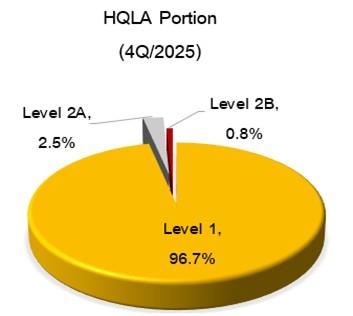
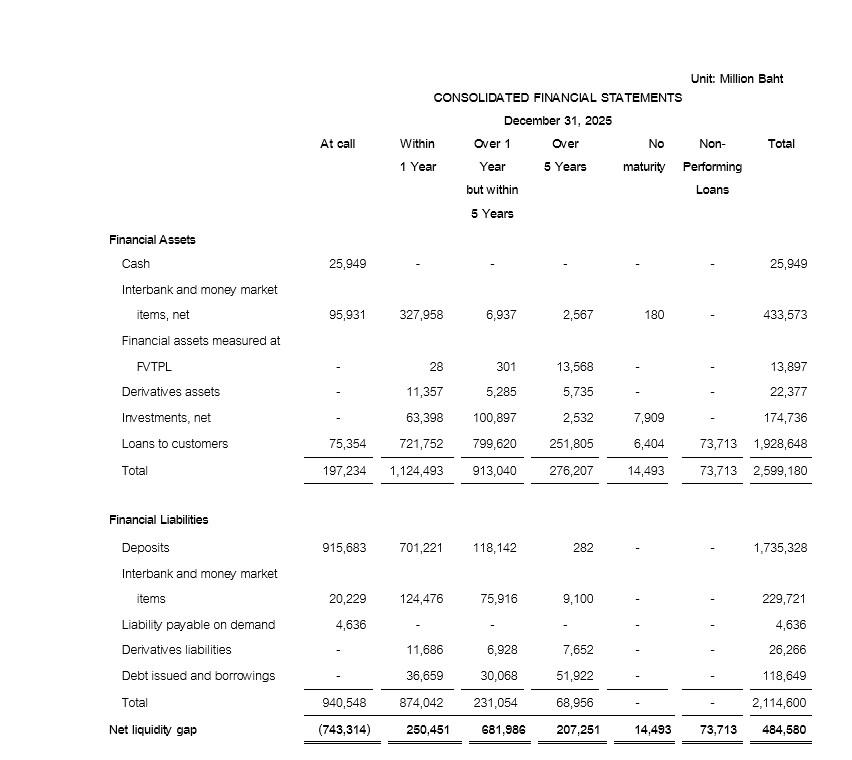
The average LCR as of the fourth quarter of 2025 was 190 percent, still well above the BOT’s minimum requirement and the Bank’s internal trigger level. The Bank had sufficient liquidity by maintaining 96.7 percent of total HQLA in Level 1 assets including government bonds, BOT bonds, public sector entity (PSE) bonds guaranteed by the Ministry of Finance, and cash, etc. Financial assets and financial liabilities based on remaining contractual maturity as at December 31, 2025 are as follows:
| Liquidity Risk Management Framework The Bank recognizes the importance of managing and controlling liquidity risk by establishing a liquidity risk management policy, including an Emergency Contingency Plan. The Bank maintains liquid assets in accordance with the criteria set by the BOT and focuses on managing excess liquidity to an appropriate level and sufficient volume for both the Bank's and the Financial Business Group. The Bank manages the liquidity both quantitatively and qualitatively to ensure appropriate risk diversification and management under the business expansion plan or any events that may affect the financial business group and the acceptable risk scope. Krungsri Financial Business Group has established a decentralized liquidity management framework, where each company determines its own guidelines, plans, execution processes and also manages funding sources. The liquidity management of group companies within the business group must adhere to the rules set forth in the liquidity risk management policy and the Bank's relevant procedures. In addition, the group company shall establish the governance guidelines, management structures, and roles and responsibilities that suits with the country in which they operate, the regulatory requirements of each country, the business model, and market and competitive conditions. The Bank will monitor to ensure that group companies within the business group manage liquidity according to the specified policies and procedures and will consider providing liquidity support to these companies while prioritizing the overall stability of Krungsri Financial Business Group. Overall liquidity risk management is overseen by the Risk and Compliance Committee (RCC), the Risk Management Committee (RMC), and the Asset and Liability Management Committee (ALCO). The Market Risk Management Division provides strategic risk management options, while the Global Markets Group proposes proper funding liquidity management strategies and manages daily liquidity positions under risk limits approved by the Board. The Bank realizes the importance of measuring tools that are suited to the size and complexity of transactions both on- and off-balance sheet. The Liquidity Coverage Ratio (LCR) is applied to short-term liquidity management to ensure maintenance of adequate liquid assets, while the Net Stable Funding Ratio (NSFR) is applied to long-term liquidity management to ensure maintenance of stable funding. A manageable level of maturity mismatches of cash flows from assets and liabilities is then consistently maintained and regularly monitored with liquidity stress testing, together with sufficient liquidity reserves. The Bank also has a liquidity contingency plan that outlines the roles and responsibilities of the management and the relevant departments, and has early warning indicators together with an action plan that allows the Bank to promptly manage crisis events and successfully resume normal operations. | 761 · Description: Insufficient sources of funding · Info category: FINANCIAL_RISK · 762 · Description: Change in financial and investment policies of financial institutions that affect business operations · Info category: FINANCIAL_RISK · 763 · Description: Default on payment or exchange of goods · Info category: FINANCIAL_RISK · 764 · Description: Fluctuation in exchange rates, interest rates, or the inflation rate · Info category: FINANCIAL_RISK · 765 · Description: Fluctuation in return on assets or investment · Info category: FINANCIAL_RISK · 766 · Description: Unhedged loan and borrowing in a foreign currency · Info category: FINANCIAL_RISK · 1724 · Description: Liquidity risk · Info category: FINANCIAL_RISK · 1725 · Description: Income volatility · Info category: FINANCIAL_RISK | ||||||||||||||||||||||||||||||||||||||||||||||||||||||||||||||||||||||||||||||||||||||||||||||||||||||||||||||||||||||||||||||||||||||||||||||||||||||||||||||||||||||||||||||||
| Operational Risk Management | Operational risk refers to the risk of losses arising from the inadequacy or failure of internal processes, systems, or personnel, or external events, including legal risks but excluding strategic and reputational risks. Such risks can occur across various business processes and may result in both financial and non-financial impacts, including breaches of laws or regulations, as well as long-term reputational damage to the Bank. The Bank recognizes the increasing operational risks from both internal and external factors, such as cyberattacks, data breaches, IT system failures, political crises, emerging infectious diseases and pandemics, as well as climate change risks like flooding, earthquakes, and other natural disasters. | If operational risks materialize, they may disrupt business continuity, impair service delivery to customers, result in financial losses, lead to non-compliance with laws and regulatory requirements, and adversely affect the Bank’s reputation and stakeholder confidence over the long term. Recognizing the significance of these potential impacts, the Bank remains committed to proactively anticipating and mitigating significant operational risks to ensure they remain within acceptable levels. This is carried out under the operational risk management policy framework approved by the Board of Directors. In addition, the Bank also emphasizes fostering a risk-aware culture by providing training and knowledge development to help employees recognize the importance of operational risk management, thereby supporting responsible business operations. The Bank manages operational risk under the Three Lines of Defense framework to ensure independent and adequate oversight of operational risk management across the organization. Business units, as the primary owners of operational risk, are responsible for identifying and managing operational risks inherent in their products, processes, and systems in accordance with the Bank's policies. The Operational Risk Management Division is responsible for designing and developing the risk management framework and reporting significant risks and risk-related incidents to senior management and relevant committees. In addition, the Internal Audit Group provides an independent check on the structure, policies, and actions taken to ensure adequacy and effectiveness of operational risk management. | The Bank has a framework and tools for managing operational risk that align with international standards. It includes processes for identifying and assessing risks, monitoring and controlling them, and continuously reporting significant risks. The Bank regularly reviews the Risk and Control Self-Assessment (RCSA) program using historical loss data and changes in the business environment to ensure an accurate reflection of the Bank’s risk profile. The Bank also conducts testing of key controls for significant risks identified in the RCSA to ensure that these controls are well-designed and consistently implemented. The Bank conducts risk assessments for new products, processes, and technologies, as well as for significant changes to existing processes and systems. These must undergo thorough analysis and evaluation of potential operational risks, information technology risks, cyber threats, and other possible risks. All assessments must be approved by the management before the products or processes are implemented. The Bank collects and monitors key risk indicators as early warning signals to detect potential weaknesses in the internal control system. If risk levels exceed acceptable thresholds, the relevant units will develop appropriate action plans to address the issue. All business units are responsible for reporting operational risk incidents, including direct and indirect losses exceeding a defined threshold, near-miss events, and non-financial impact incidents, to the Operational Risk Management Division. The Bank has established a significant incident management working group to analyze root causes, develop effective preventive measures, and share lessons learned. These insights are leveraged to enhance risk management practices across other business units effectively. In addition to the abovementioned tools, the Bank has implemented an application for operational risk management system (ORMS) to support the monitoring and reporting of risks. This enables employees to manage operational risks more efficiently. The Bank continuously develops our business partner risk management processes, focusing on data security, personal data protection, complaint handling, business continuity, and comprehensive risk management, particularly in the areas of reputational risk, operational risk, and information technology risk. The Bank prioritizes business continuity management to ensure uninterrupted customer service during crises or unforeseen events. During the earthquake incident in March 2025, the Bank effectively managed our business continuity. We have strengthened and refined our plans based on lessons learned from this event. Additionally, the Bank has improved the crisis notification process (Call Tree) through an internal mobile application, which reduces the time and resources needed, while enhancing the efficiency and speed of crisis communication. Capital Requirement We currently use the Standardized Approach (SA) to calculate operational risk capital. Details of the capital requirements are in the following table. Krungsri Operational Risk Minimum Capital Requirements Unit: Million Baht
| 755 · Other name: - · Description: Other · Info category: OPERATIONAL_RISK | ||||||||||||||||||||||||||||||||||||||||||||||||||||||||||||||||||||||||||||||||||||||||||||||||||||||||||||||||||||||||||||||||||||||||||||||||||||||||||||||||||||||||||||||||
| Information Technology Risk Management | Information technology risk, or IT risk, is the potential risk in using information technology to run a business. This could affect the systems or operations of the Bank and includes the risk of cyber threats and the risks incurred from third parties. | If IT risks materialize, they may lead to service disruptions, data breaches, financial losses, regulatory non-compliance, and reputational damage, which could ultimately undermine customer confidence and the Bank’s long-term performance. Recognizing the significance of these potential impacts, the Bank places great importance on IT risk management, recognizing it as a critical component of the enterprise-wide risk management framework. Sufficient resources are allocated to effectively manage these risks, ensuring they remain within acceptable levels. IT risk management is integrated into the Bank’s operational risk framework and information security management, focusing on the confidentiality, integrity, and availability of systems and data, as well as the protection of customer information. These efforts aim to enhance customer confidence and trust in the Bank. | To effectively manage IT risk, the Bank established an IT risk management policy covering the organizational structure, roles, and responsibilities of the committees and related parties according to the Three Lines of Defense model. The Bank developed the appropriate IT risk management framework, which is aligned with the Bank’s operational risk management framework, to ensure that such risks, including the risks incurred from cyber threats, the use of third-party services, and IT project management are identified, assessed, monitored, controlled, and reported. In this regard, the process of the IT risk management framework covers risk assessment, treatment, monitoring and review, and reporting. The Bank has identified all potential types of IT risks to establish a comprehensive IT risk universe for effective risk management. IT risk assessments are conducted at the enterprise level, for critical systems, and in compliance with regulatory requirements. These assessments enable the Bank to clearly identify vulnerabilities and critical risks, facilitating the development and implementation of appropriate preventive measures to mitigate potential impacts effectively. This has strengthened the Bank’s information technology risk management, making it robust and reliable, and enabling sustainable business operations in the digital era. The Bank has developed key IT risk indicators which correspond to the significance of critical systems of the Bank in order to monitor and keep IT risk levels under the relevant risk appetite. The Bank has collected and analyzed IT risk incidents that have occurred, including the monitoring of IT risk trends that could impact the Bank. The Bank has developed a policy that controls the testing of financial services with the utilization of financial technology (Own Sandbox). The policy aims to control the use of new technology in creating, developing, and improving products or services. Hence, we can be assured that such financial innovations meeting the specified criteria can be deployed under the stipulated requirements and environment. The Bank manages third-party risks under the IT risk management framework, emphasizing the importance of monitoring and managing risks arising from the use of, connection with, or access to third-party services and data. This is carried out in alignment with the level and significance of the associated risks. The Bank has established and implemented the processes for risk assessment, IT security, and cyber threat prevention. These measures ensure the confidentiality, integrity, and availability of systems and data, fostering trust and security in business operations with third parties. On top of that, the Bank has in place a process to manage and report significant IT incidents or problems as well as significant cyber threats or attacks. Such issues are reported to the designated committees, the Bank of Thailand (BOT), or relevant regulatory authorities as required. | 755 · Other name: - · Description: Other · Info category: OPERATIONAL_RISK | ||||||||||||||||||||||||||||||||||||||||||||||||||||||||||||||||||||||||||||||||||||||||||||||||||||||||||||||||||||||||||||||||||||||||||||||||||||||||||||||||||||||||||||||||
| Emerging risks | In 2025, the Bank monitored the risk arising from extreme weather through the Enterprise-wide Risk Management Framework. Krungsri conducted an assessment and tracking of ‘climate-related risk, in case of earthquake and inundation’. In addition, the Bank appointed the Sustainable Committee and related committees to set up related credit management frameworks as well as criteria for considering other risks as well. | The Bank has estimated the impact on customers from the earthquake and has the relief measures for impacted customers, especially condominiums, hotels, apartments, and office buildings. | For inundation, the Bank has a debt restructuring program to relieve debtors affected by the flood and closely monitor this situation. | 737 · Other name: Emerging Risks · Description: Other · Info category: STRATEGIC_RISK | ||||||||||||||||||||||||||||||||||||||||||||||||||||||||||||||||||||||||||||||||||||||||||||||||||||||||||||||||||||||||||||||||||||||||||||||||||||||||||||||||||||||||||||||||
Risks to Securities Holders' Investment
Risk Register
| Risk Name | Risk Characteristics | Consequences | Related Risk Factors |
|---|---|---|---|
| Shareholder Risk | Shareholder risk refers to the possibility that returns from investing in securities may not meet investors’ expectations. Fluctuations in the Bank’s share price may arise from variations in external factors affecting the Bank’s operating performance, such as domestic and international economic conditions, political situations, cross-border capital flows, changes in government policies affecting the commercial banking system, as well as unforeseen events. In this regard, returns on investment in the form of dividends depend on the Bank’s operating results and its dividend payment policy in each year. | Nevertheless, the Bank has a stable shareholder structure, with a major shareholder, MUFG, holding a significant ownership stake. This contributes to relatively lower share price volatility compared with the overall market. In addition, the Bank is committed to continuously achieving its financial objectives while exercising prudent risk management, with the aim of delivering stable and sustainable returns to shareholders over the long term. | 769 · Other name: - · Description: Other · Info category: HOLDER_RISK |